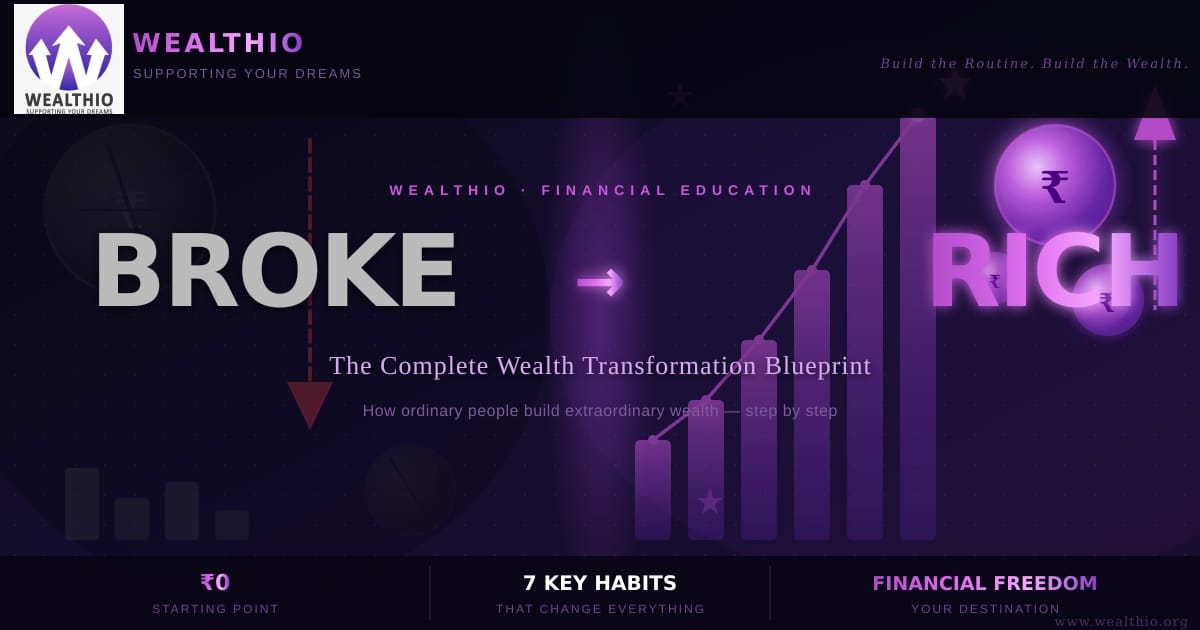
Why lifelong wealth isn’t about working harder—it’s about rewriting your psychological rules of money. Most people believe that the path from financial struggle to wealth is paved with complex mathematical formulas, stock market secrets, or grueling 80-hour workweeks. We are conditioned to think that if we just save a little more, sacrifice our daily luxuries, or work ourselves to exhaustion, wealth will naturally follow.
But reality reveals a far more profound truth. Wealth is not a mathematical problem; it is a psychological and systemic one. True financial transformation—moving completely from a state of being ‘broke’ to being genuinely ‘rich’—begins long before a single dollar enters your bank account. It requires a radical restructuring of how you perceive value, time, risk, and security. This guide breaks down the core structural frameworks necessary to dismantle a scarcity mindset and build an unshakeable ecosystem for lifelong freedom.
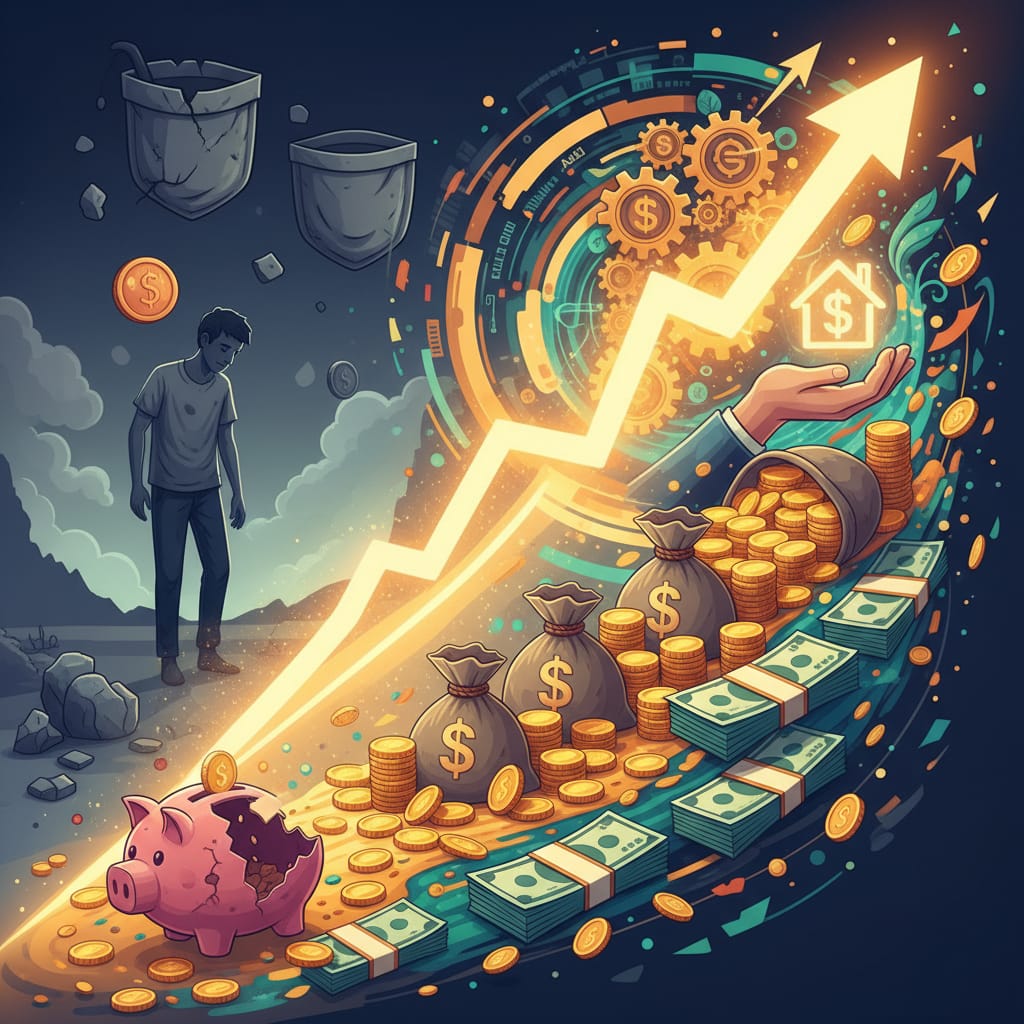
1. The Psychology of Abundance: Overcoming Scarcity Programming
At the heart of systemic financial struggle lies what psychologists call ‘scarcity programming.’ This is a deeply ingrained mental framework where money is viewed exclusively through the lens of fear, anxiety, and absolute limitation. When operating under a scarcity mindset, every financial decision becomes defensive. You focus entirely on minimizing loss rather than maximizing growth.
To transition to an abundance-driven rich mindset, you must first redefine what wealth actually means. True wealth is never measured by material flashiness, luxury vehicles, or keeping up appearances. Instead, wealth is measured in choices, autonomy, and ‘freedom capital.’ A rich mindset views money not as an object to be hoarded for a false sense of safety, but as an active tool—a renewable resource meant to be leveraged. When you stop viewing money as something that controls you and start viewing it as an employee you direct, your relationship with risk and opportunity completely transforms.
💡 Core Shift: A broke mindset asks, ‘How can I protect what little I have?’ A rich mindset asks, ‘How can I deploy my resources to buy back my autonomy?
2. Escaping the ‘Hard Work’ Paradox: The Power of Leverage
One of the most pervasive social myths is the ‘Hard Work Trap.’ We are taught from childhood that trading physical hours for corporate dollars is the sole legitimate path to security. If you want more money, the traditional logic dictates that you simply need to work longer hours or take on multiple jobs.
While initial discipline and strong work ethic are critical foundational attributes, relying solely on active, linear income is a financial treadmill. If you stop running, the income stops flowing. The wealthy understand a fundamental truth: you cannot achieve true financial freedom by selling your limited time.
Instead of maximizing physical labor, the rich focus entirely on maximizing leverage and ownership. This means shifting your daily energy from being a replaceable component inside a machine to becoming the master architect of the machine itself. Leverage comes in many modern formats: scaling scalable business models, delegating administrative tasks, creating intellectual property, or utilizing software automation. By completely decoupling your primary income from your physical hours, you build a system that generates value around the clock.

3. The Savings Illusion: Moving from Hoarding to Reinvestment
Traditional personal finance advice heavily emphasizes extreme frugality and aggressive savings. While eliminating high-interest consumer debt and establishing a basic emergency buffer are essential first steps, savings alone will never bridge the gap to actual wealth. In reality, within an inflationary economic climate, hoarding un-deployed cash is a guaranteed way to consistently lose purchasing power. The broke mindset treats savings as the final destination—a stagnant pile of cash to look at for emotional comfort. Conversely, the rich mindset treats surplus cash strictly as seed capital,
Money has an explicit job, and that job is to compound and grow. Instead of letting capital stagnate in low-interest retail bank accounts, wealthy individuals systematically channel their surplus into high-yield environments: upgrading high-income specialized skills, expanding scalable business ventures, or acquiring cash-flowing assets like real estate or equity portfolios. The ultimate goal is to transition rapidly from a standard consumer to an aggressive asset investor
4. Breaking the Addiction to Comfort: Radical Responsibility
Human beings are biologically wired to seek comfort and avoid uncertainty. However, when it comes to long-term financial growth, comfort is an exceptionally expensive addiction. Settling for a predictable but uninspiring corporate routine, a flatlined paycheck, or a low-risk environment provides temporary psychological safety, but carries a massive, invisible opportunity cost over time.
To successfully move from broke to rich, you must trade the illusion of comfort for radical responsibility. This requires entirely discarding the victim mentality. It means recognizing that regardless of your upbringing, past financial mishaps, or external macroeconomic conditions, you are the absolute chief executive officer of your own financial future. When you take absolute accountability, you stop placing blame on external systems and start executing cold, strategic choices that actively propel you forward.
5. Building Wealth Infrastructure: Systems Over Willpower
Relying on raw willpower to build long-term wealth is an inherently losing strategy. Everyday life is full of emotional triggers, fatigue, and sudden impulses that drain our mental energy. If your financial plan relies on your ability to make the ‘right analytical choice’ every single day, it is structurally fragile.
The wealthy eliminate human error by engineering automated financial infrastructure. They design rule-based systems where money is automatically distributed into predefined asset buckets the microsecond it is earned: a precise percentage goes straight to investment brokerages, a percentage to business development, and a percentage to operation costs. By automating your financial ecosystem, wealth accumulation happens silently, consistently, and entirely independent of your temporary emotional states.
📊 Systems Rule: You do not rise to the level of your financial goals; you fall to the level of your automated systems.
Conclusion: The Ultimate Destination of Wealth
The journey from broke to rich is far more than a simple numerical transition on a banking application; it is an internal identity shift. It requires trading defensive fear for strategic focus, linear manual labor for structural leverage, and immediate comfort for long-term absolute autonomy. The true purpose of building wealth is never to purchase luxury items to impress an audience—it is to permanently buy back your time, your peace of mind, and your unconditional right to choose how you experience the world.
-Admin, Wealthio