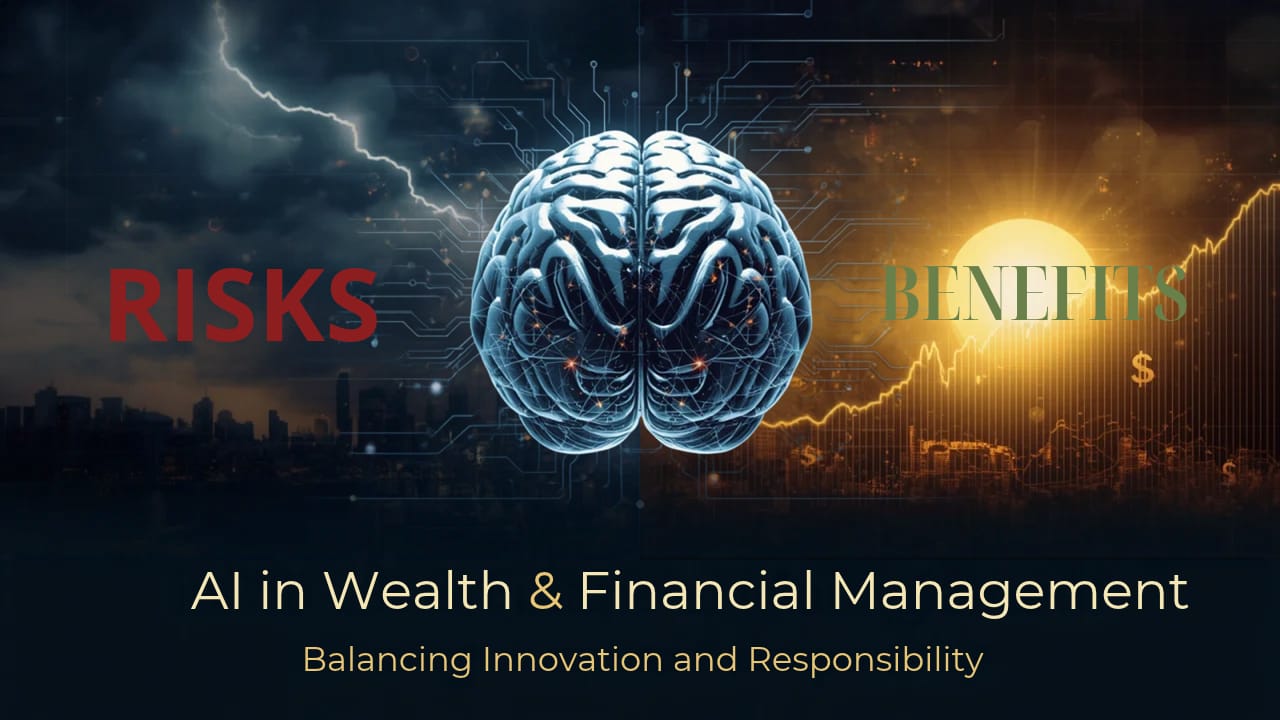
“Think about how you managed your money five years ago. You looked at spreadsheets, read financial news, and maybe spoke to an advisor once a quarter. In this article, we are breaking down exactly how AI is changing wealth management, and more importantly, how you can use it to accelerate your own wealth creation.
Imagine your financial advisor never sleeps, never gets emotional during a market crash, and can analyze thousands of data points in the time it takes you to sip your coffee. That’s not science fiction anymore — that’s Artificial Intelligence, and it’s completely reshaping how wealth is managed and created today. For decades, wealth management was a privilege — reserved for those who could afford expensive advisors and had six-figure portfolios to start with. AI is breaking that barrier. This means someone starting with even a small amount can now access portfolio strategies that were once only available to high-net-worth clients.

Today Artificial Intelligence is quietly rewriting the rules of how wealth is created, managed, and multiplied. If you think AI in finance is just about chatbots or high-speed Wall Street trading, you’re missing the bigger picture. Right now, in 2026, AI is directly impacting your personal net worth—whether you realize it or not. “First, let’s talk about daily financial management. For decades, the biggest barrier to wealth creation wasn’t a lack of money—it was a lack of time. Tracking expenses, budgeting, and optimizing taxes felt like a second full-time job.
AI has completely automated the boring stuff. Modern financial tools don’t just track where your money went; they predict where it’s going. They analyze your spending habits to forecast your cash flow three months down the line. They find hidden subscriptions you forgot to cancel. They scan shifting tax codes in real-time to find legal deductions you would have completely missed. In short: AI is turning your chaotic financial life into a hyper-automated, efficient wealth machine. It frees up your most valuable asset—your time—so you can focus on making big strategic moves. But here is where the real magic happens: Wealth Management.
Historically, elite financial strategies—like advanced risk profiling, tax-loss harvesting, and alternative asset access—were locked behind a velvet rope. You needed millions of dollars just to get a meeting with the analysts who handled these things. AI has democratised institutional-grade investing. Today, advanced Large Language Models and machine learning algorithms act like a pocket-sized quantitative analyst for everyday investors.
This means:
-Faster fraud detection protecting your accounts,
– More accurate risk profiling based on real behavior, not just a questionnaire.
– Personalized financial plans that adjust dynamically as your life changes — a new job, a new baby, a market downturn.
In short, AI is turning financial planning from a static, once-a-year conversation into a living, breathing, constantly updating strategy.
- Hyper-Personalisation: AI doesn’t just put you into a generic ‘moderate risk’ bucket. It looks at your unique career trajectory, your real estate, your geographic location, and your exact timeline to build a truly bespoke portfolio. Here’s the part that excites me most. AI is closing the gap between the wealthy and everyone else. Tools once reserved for institutional investors — like algorithmic trading, tax-loss harvesting, and predictive analytics — are now built into apps ordinary people use every day. This is genuinely democratizing wealth creation, giving more people the tools to grow their money intelligently, not just save it.
- Instant Document Crunching: Instead of spending weekends reading 100-page corporate financial filings or earnings transcripts, you can use AI to instantly summarize the risks and opportunities of a stock. It gives regular investors the same analytical processing power that used to require a team of Ivy League analysts. Now, it’s not all sunshine and automated profits. To build lasting wealth, you have to survive the risks.
The winning formula for wealth creation isn’t AI replacing humans. It’s humans leveraging AI. Use the tech for data and speed, but keep your human judgment for strategy and discipline.”
The ‘Black Box’ Trap: Many AI trading tools make predictions based on complex data patterns, but they can’t tell you why they made that choice. If a market regime shifts suddenly, a ‘black box’ model can fail spectacularly. Relying blindly on AI can ruin your portfolio if you aren’t careful.
The Echo Chamber: If everyone uses the same AI models to analyze the same market data, it creates massive herd behavior. This leads to intense market volatility and sudden intraday crashes.
Losing the Human Touch: AI is brilliant at math, but it has zero emotional intelligence. It doesn’t know your human fears, your family dynamics, or the emotional discipline needed to hold through a market panic.
But let’s be balanced here, because AI isn’t a magic wand. Over-reliance on algorithms can be dangerous — markets are also driven by human psychology, geopolitics, and events AI can’t always predict.
– Data privacy is a real concern, since these tools need deep access to your financial information.
– The human touch still matters — especially during emotional financial decisions, like retirement planning or family wealth transfer, where empathy and judgment matter as much as numbers.
The smartest approach isn’t choosing AI or human advisors — it’s combining both. Let AI handle the data crunching and pattern recognition, while humans handle strategy, empathy, and big-picture judgment. “The bottom line is this: AI is the ultimate leverage. The individuals who learn to collaborate with these tools are going to build wealth at a speed we’ve never seen before. The ones who ignore it risk getting left behind.
So what should you actually do with this information?
- Explore AI-powered investment tools, but understand what’s happening behind the scenes — don’t blindly trust a black box.
- Use AI for data — but keep a human perspective for major decisions.
- Stay financially literate. AI can execute strategy, but you still need to understand the “why” behind your money moves.
AI is not replacing wealth management — it’s redefining it. It’s making financial growth more accessible, more personalized, and more data-driven than ever before. But the winners in this new era will be the people who combine AI’s power with their own financial awareness.
-Admin, Wealthio