From negotiation and adaptability to communication and clear thinking nine future-proof skills that matter more than a degree. Roles disappear, tools go obsolete, and entire industries get rewritten within a few years. What doesn’t get rewritten are the underlying skills that make a person valuable, in any job, in any economy, in any decade. These are not the skills you list on a resume. They are the skills that quietly decide how much you earn, how fast you grow, and how replaceable you are.
Once you step into the real world, your growth depends on something deeper. The people who stay relevant are not always the ones with the most certificates; they are the ones who learn how to sell ideas, adapt fast, think clearly, manage time, and communicate with purpose. This article breaks down nine skills that are useful across careers, businesses, and life. Each skill is practical, timeless, and worth building one step at a time.
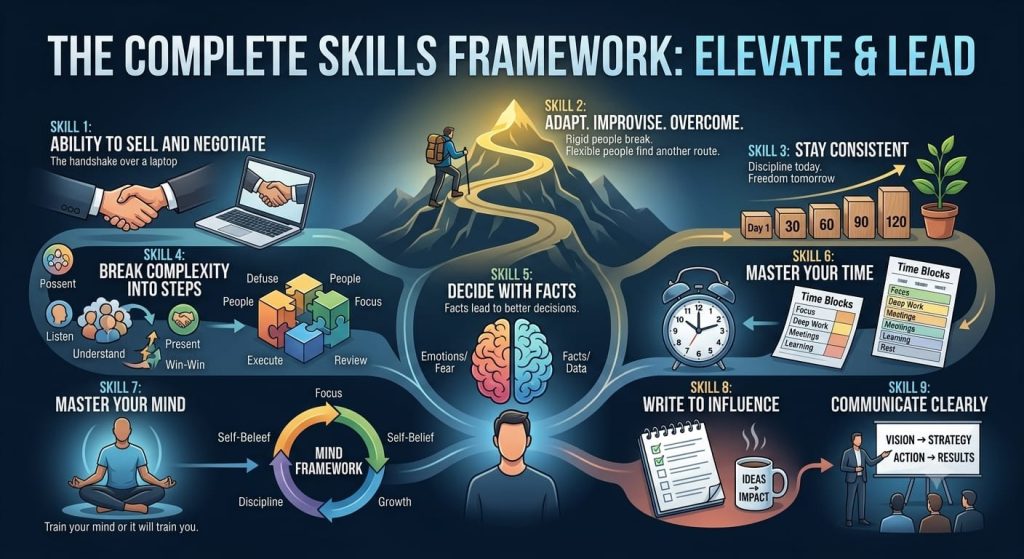
- Sell and Negotiate
It’s the ability to make someone else see the worth of what you’re offering, the ability to explain value, build trust, and persuade others with clarity. Negotiation helps you reach better outcomes without creating conflict A strong communicator can make good work visible, and visibility often creates opportunity.
2. Adapt, Improvise, Overcome
Adaptable people stay calm, observe the situation, and choose a new route when the original plan no longer works. This skill matters because real life rarely follows the script. The more comfortable you become with change, the faster you can recover, learn, and move forward. In wealth-building terms, this is what separates people who recover from a bad year from people who never try again.
3. Stay Consistent– Talent opens the account. Consistency compounds it.
Consistency matters because talent may start the journey, but repetition finishes it. Consistency builds trust, mastery, and momentum. This is the whole idea behind Wealthio. Nobody builds wealth in a single burst of motivation — they build it in the repeated act of showing up. Intensity feels productive. Repetition is what actually moves the number.
4. Break Complexity Into Steps
Big problems don’t get solved. They get divided. Whether it’s a messy financial plan, a stalled project, or a career pivot — complexity is what stops most people before they start. The people who move fast aren’t smarter; they’re better at cutting a large, intimidating problem into small, doable steps and just starting with the first one.
5. Decide With Facts
Feelings fluctuate day to day. Facts compound over years. Data helps you see the situation more clearly and avoid quick reactions that may lead to regret. The single biggest wealth-destroyer is an emotional decision made at exactly the wrong moment — panic-selling an investment, quitting a good job on a bad day, spending to soothe a feeling. People who build real wealth learn to pause, check the numbers, and let facts — not moods — drive the decision.
6. Master Your Mind
What you tolerate internally eventually becomes your external reality. Mastering your mind isn’t a soft skill sitting on the side; it’s the operating system every other skill runs on. If you tolerate self-doubt, fear, or negative habits for too long, they begin to shape your actions. Mental discipline helps you stay focused, manage pressure, and keep going when progress is slow.
7. Write to Influence
Words shape perception. Perception shapes decisions In a world where most first impressions happen through a screen — an email, a message, a proposal — the ability to write clearly and persuasively is a direct financial skill. A well-written message can move a deal, a hire, or a client decision in your favour before you’ve ever spoken a word out loud. People often judge the quality of an idea by how well it is expressed.
8.Communicate Clearly
Confusion creates friction. Clarity creates movement. Clear communication is the skill that connects all the others. It helps teams align, leaders lead, and ideas move from thought to execution. In a noisy world, clarity is a competitive advantage. Clarity is a form of respect for other people’s time, and it is consistently rewarded — with trust, with speed, and eventually, with money.
How to build these skills in real life ?
Choose one skill each month and practice it deliberately.
• Read, observe, and apply what you learn in real conversations and projects.
• Track small wins so you can see progress over time.
• Use mistakes as feedback instead of proof that you are not good enough.
“The world doesn’t reward what you know. It rewards what you can make others understand.”
-Admin, Wealthio