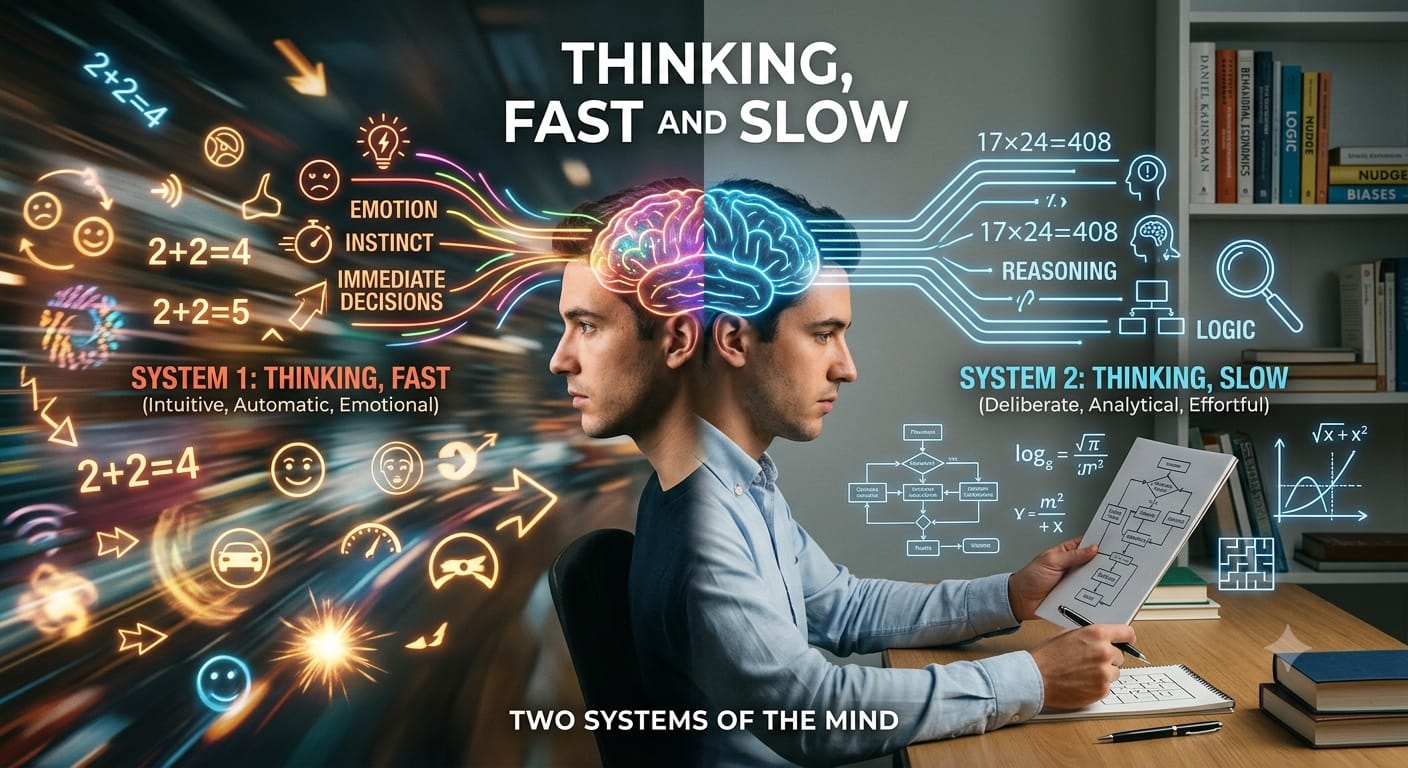
Daniel Kahneman, a Nobel Prize-winning psychologist and author of this Book “Thinking, Fast and Slow”, spent decades studying how people actually make decisions. “Thinking, Fast and Slow” explores one of the most important questions in human behavior: Why do we make the decisions we make?
Our minds operate through two different styles of thinking. Understanding these systems can help us recognize emotional mistakes, improve judgment, and make better financial decisions.
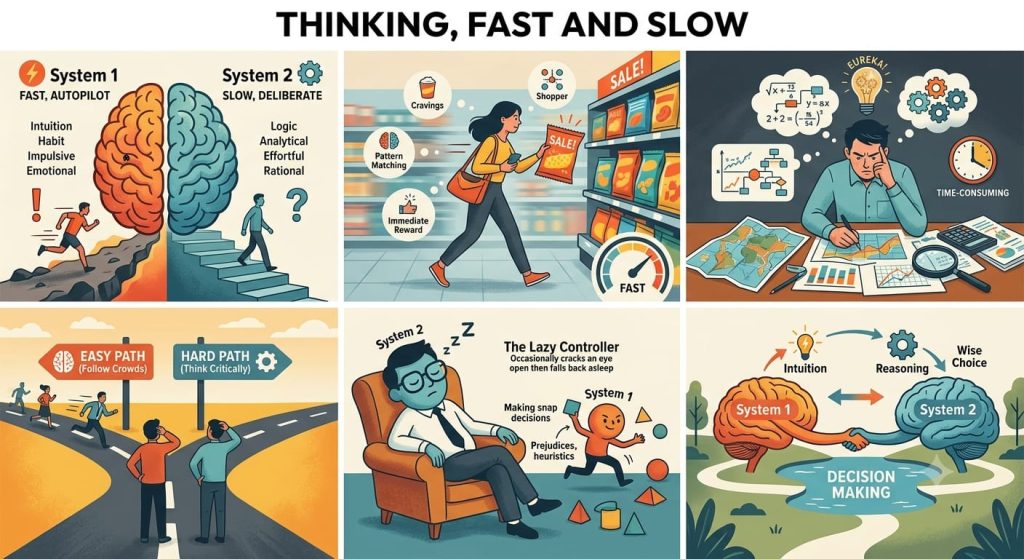
System 1 is automatic, quick and intuitive. It helps us make everyday decisions without conscious effort. It is useful when we have experience and familiar situations, but it can also produce mistakes because it relies heavily on shortcuts and emotions.
System 2 is deliberate, analytical and effortful. It becomes active when we need to concentrate, calculate, compare alternatives or question our initial assumptions.
Good financial decisions often require System 2: examining cash flow, valuation, risk, diversification, investment objectives and time horizon rather than simply following a feeling .

Why Investors Make Mistakes :
Being intelligent does not automatically make us rational decision-makers.
Overconfidence :- Confidence should be supported by evidence, not simply by past success.
Loss Aversion:- A rational investment decision should focus on future potential, not emotional attachment to the purchase price.
Anchoring:- Evaluate investments based on current fundamentals rather than arbitrary reference points.
Availability Bias:- News creates attention; evidence should create conviction.
People naturally look at what others are doing when they are uncertain. This can create bubbles and panic. Investors may buy because everyone else is buying and sell because everyone else is selling. Popularity is not the same as value.
Good financial decisions require a process
Building wealth is not simply about earning more money. It is also about avoiding costly mistakes. An investor who consistently avoids emotional decisions, unnecessary speculation, excessive debt, poor diversification and impulsive buying may have a significant advantage over someone who constantly tries to predict the market.
Better decisions can be more valuable than better predictions.
We cannot know exactly what markets will do tomorrow. But we can control how we respond to uncertainty.
Five Financial Lessons:
1. Slow down important decisions.
The bigger the financial consequence, the more valuable deliberate analysis becomes.
2. Question your first reaction.
Your immediate judgment may be useful—but it may also be biased.
3. Accept that losses are part of investing.
Trying to avoid every loss can lead to even greater mistakes.
4. Build systems instead of relying on willpower.
Investment rules, diversification and disciplined review processes can protect us from emotional decisions.
5. Know your own biases.
The greatest risk in investing is not always the market. Sometimes it is the investor’s own behaviour.
Final Takeaway
The smartest investor is not necessarily the person who can predict the market perfectly. It may be the person who can recognize their own biases, slow down when necessary and follow a disciplined decision-making process.
Wealth is built not only by making profitable decisions, but also by preventing avoidable mistakes. That simple pause can be the beginning of better financial thinking. Anyone making financial decisions, that awareness alone can be worth far more than any specific tip or trick.
-Admin, Wealthio