
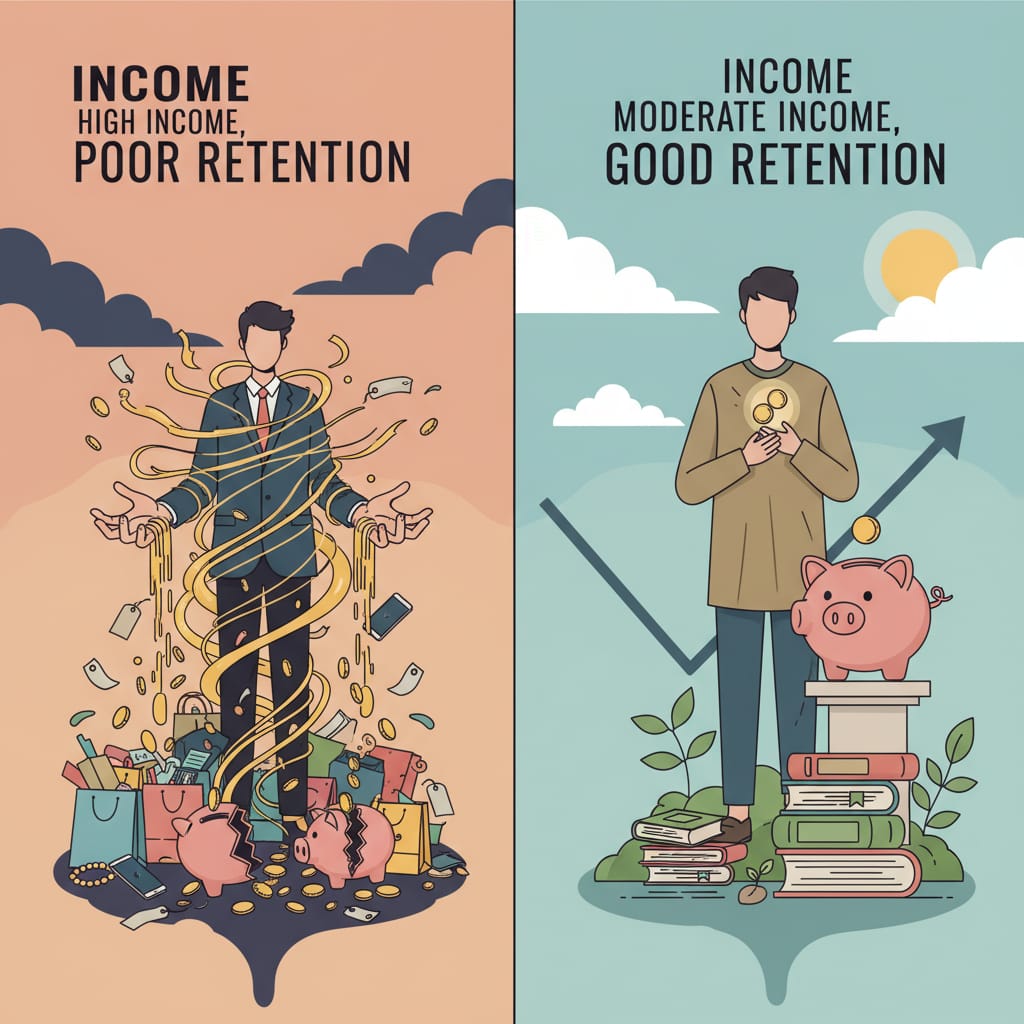
Most people believe that if they just earned more, their money problems would disappear. But talk to enough people across income levels, and a strange pattern emerges: the person making ₹40,000 a month and the person making ₹4,00,000 a month often feel the same financial anxiety. Neither has enough saved. Neither feels secure. Both are one bad month away from stress. If income were the real problem, more of it should fix things. For most people, it doesn’t. That’s because the real problem was never income. It’s retention.
What “Retention” Actually Means
Retention is simple: how much of what you earn actually stays with you and for how long. Every rupee that enters your life falls into one of two paths. It either passes through — spent, gone, forgotten within days — or it stays, becoming savings, investments, or assets that generate more money over time. Most people are extremely good at earning and extremely bad at keeping. Income rises with every raise, every bonus, every new client. But somehow, the bank balance at month-end looks the same as it did two years ago.
Why More Income Doesn’t Fix It
When income increases, spending tends to increase right alongside it — often invisibly. A raise becomes a nicer apartment. A bonus becomes a better phone. A new client becomes weekend trips that “you deserve.” None of these choices feel irresponsible in the moment. Each one seems justified. But together, they form a ceiling that rises exactly as fast as income does.
Doubling your salary rarely doubles your savings. Without a retention system, more income just means a more expensive version of the same stress.
The People Who Build Wealth Do One Thing Differently
They don’t necessarily earn more than everyone else. They keep more of what they earn — deliberately, consistently, before spending happens rather than after. This shows up as a simple, boring habit: deciding what percentage of every rupee earned gets set aside first, before it has the chance to disappear into daily life.
Fixing a Retention Problem
The good news is that retention is far easier to fix than income. You don’t need a new job, a promotion, or a lucky break. You need a system that decides where money goes before you get the chance to decide it for yourself.
– The moment income arrives, move a fixed percentage into savings or investments — before any spending happens.
-Track where money actually goes
-When income rises, let savings rise faster than spending does.
-The space between income and expenses is where wealth is built. Guard it like it’s the most valuable thing you own — because it is.
Wealth isn’t built by how much passes through your hands. It’s built by how much you choose to keep.
The question was never “How do I earn more?”
It’s “How do I keep more of what I already earn?”

Wealthio could actively guide people on retention. At Wealthio, we believe that smart financial habits create lasting prosperity. Start focusing not only on increasing your income but also on improving your retention, and you’ll be surprised how quickly your financial future begins to change.
-Admin, Wealthio